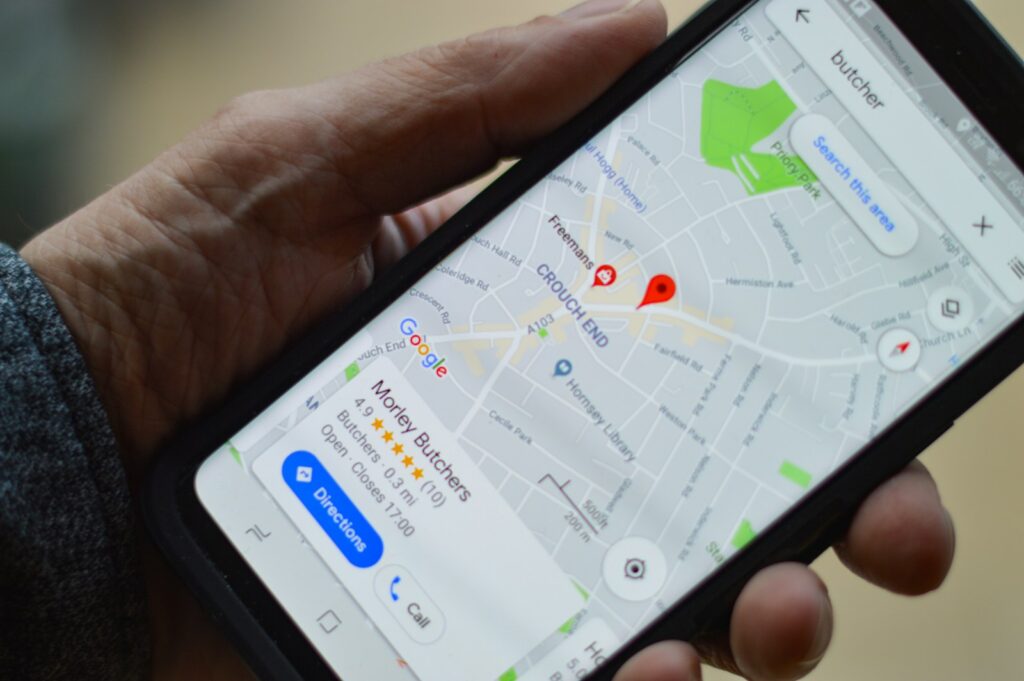
“Near me” SEO comes down to three factors Google has confirmed it uses to rank local results — relevance, proximity, and prominence — and almost none of them involve the literal phrase “near me” appearing anywhere on your site. 76% of people who search “near me” on their phone visit the business within a day, and 31% complete a transaction on the spot. Few search behaviors convert this fast. Optimizing for the wrong signals here doesn’t just underperform — it wastes the highest-intent traffic your business will ever see.
You Don’t Rank for “Near Me.” You Rank for Three Specific Signals.
Nobody optimizes a page around the literal phrase “near me” and wins — Google resolves it automatically using the searcher’s actual location combined with what it knows about your business. What it knows breaks into exactly three buckets, and understanding which one your business type depends on most changes where you should actually spend effort.
Relevance measures how well your listing and site match what the searcher wants — your category, the services listed, the language in your reviews. Proximity is simply how physically close you are to the searcher, and it’s one of the most heavily-weighted factors specifically for “near me” queries, more than for local search generally. Prominence reflects how well-known and trusted your business is — reviews, backlinks, citations, mentions — the reputation signals that exist independent of any single search.
Try It: Which Factor Matters Most for Your Business?
Someone searching “coffee near me” wants the closest good option, full stop. Category accuracy (cafe vs. restaurant vs. bakery) and up-to-date hours matter almost as much as distance — a top result that’s currently closed is a wasted click Google penalizes over time.
Emergency “near me” searches are the most proximity-weighted category that exists — someone with a burst pipe is not comparison shopping. Prominence still matters for the shortlist, but if you’re not within a reasonable radius, none of your other signals get a chance to matter.
Professional services searches lean less on split-second proximity and more on trust signals — reviews, credentials, how your firm is discussed elsewhere online. Someone will drive across town for the right lawyer in a way they won’t for a coffee.
Healthcare “near me” searches balance convenience (nobody wants a 45-minute drive for a filling) against trust (nobody wants the cheapest, closest, worst-reviewed option either). This is the category where getting all three factors right pays off the most, because none of them alone is decisive.
Interactive tool showing which of Google’s three local ranking factors — relevance, proximity, or prominence — matters most for four business types: restaurants, emergency services, professional services, and healthcare.
The Single Factor With Outsized Weight: Your GBP Category
According to the most recent expert survey of local SEO practitioners, primary category selection on your Google Business Profile is rated the single most important local ranking factor overall — ahead of reviews, ahead of backlinks, ahead of on-page content. That’s a strange thing to be the most important factor, because it’s also the thing businesses get wrong most casually: picking the closest-sounding category during setup and never revisiting it.
A “Dentist” categorized as “Medical Clinic” isn’t lying, exactly — but it’s telling Google’s matching algorithm something subtly different from what searchers are actually typing, and subtle mismatches compound across thousands of queries. We routinely find this exact error on new client accounts: a business correctly named and described, quietly mis-categorized since the profile was created years ago, invisible to an entire slice of “near me” searches nobody noticed it was missing.
Worth saying plainly: Google Business Profile allows a primary category plus several secondary categories, and the temptation is to select every category that’s even loosely applicable, hoping to catch more searches. We’d argue that’s backwards. Piling on secondary categories that don’t precisely fit dilutes the relevance signal for the ones that do — a restaurant that also tags itself as “Event Venue,” “Catering,” and “Bar” when those aren’t genuinely core to the business ends up moderately relevant to four categories instead of highly relevant to one. Narrow and accurate beats broad and approximate here.
Reviews: Recency Beats Volume, and Most Businesses Have This Backwards
76% of near-me searchers visit the business within a day, 31% complete a transaction in the same session, and the top three local pack positions capture a combined 43% click-through rate.
A business with 100 reviews collected three years ago and nothing since will typically lose ranking ground to a competitor with 50 reviews, ten of which arrived in the past month. Google reads review recency as an active-business signal, separate from review volume or even average rating. This runs against most owners’ instincts — a five-star business with a big historical review count assumes it’s “done” with reviews, when the data suggests the opposite: a steady, ongoing trickle of new reviews outperforms a large but stale archive.
The Backlink Signal Nobody Local Thinks to Build
Here’s the one that surprises most local business owners: the percentage of your backlinks carrying your city or region in the anchor text correlates strongly with “near me” search performance specifically, separate from your total backlink count. A mention from a regional chamber of commerce, a local news write-up, or a neighborhood business directory that links to you with your city name in the link text is doing local-ranking work that a generic, high-authority link from an unrelated national site simply can’t replicate. This is a genuinely different link-building objective than the domain-authority chase most SEO content focuses on — it’s covered in more depth from the acquisition side in our link building guide.
A Quick Self-Check Table
| Signal | Quick check | Common failure |
|---|---|---|
| GBP category | Is your primary category the exact term customers search, not just a near-synonym? | Set once at signup, never revisited |
| Review recency | Have you had a new review in the last 30 days? | Relying on an old review archive |
| NAP consistency | Does your name/address/phone match exactly across every directory? | Old address lingering on a forgotten directory listing |
| Geo-anchored links | Do any backlinks use your city name in the link text? | All links are generic “click here” or brand-name anchors |
Where This Leaves Multi-Location Swiss Businesses
If you operate in more than one canton, treating every location as a satellite of one central profile is a common shortcut that costs rankings — each location needs its own accurately-categorized Google Business Profile, its own local citations, and ideally its own geo-anchored links, because proximity is evaluated per search, per location, not once for the brand as a whole. A Zürich searcher and a Basel searcher looking for the “same” business are functionally running two separate ranking evaluations, and treating them as one often means neither location gets fully optimized. This is also where cross-cantonal review language quietly matters: a location with predominantly German-language reviews signals relevance differently than one with a mix of German and French, and syncing your response language to the reviewer’s language — rather than defaulting to one house style — is a small, underused prominence signal in a multilingual market.
The mistake compounds when the locations share one website with a single “Locations” page listing addresses in a table. That page satisfies a human visitor fine. It does very little for “near me” ranking, because there’s no dedicated, individually-optimized page for Google to associate with each specific location’s proximity signal. Each location generally needs its own landing page — same brand voice, genuinely distinct local content, not a templated address swap — to give each profile something substantive to point to.
The Part Almost Nobody Mentions: Page Speed on Mobile
Near-me searches are overwhelmingly mobile — someone standing on a street, phone in hand, deciding in the next ten seconds where to walk. A slow-loading location or service page doesn’t just lose the click; it loses it before Google’s ranking signals even get a chance to matter, because a meaningful share of mobile searchers abandon a slow page before it finishes rendering. This connects directly to Core Web Vitals, which we’ve covered in detail elsewhere, but the local-specific point is this: your homepage being fast doesn’t help if your location page — the one page actually surfaced for a near-me search — is the one nobody bothered to optimize. We’ve audited local business sites where the homepage scored well on every speed test and the actual location page, buried three clicks deep with unoptimized images, loaded in over six seconds on a mid-range phone. Google’s crawler and the human it’s trying to serve both notice that gap, even when the site owner never checks that specific page.
What We’d Actually Do in the First 30 Days
Faced with a new local client, here’s the order we work in, and it’s deliberately not alphabetical or theoretical — it’s ranked by how fast each fix tends to move the needle relative to the effort it takes.
- Audit the GBP category and attributes first. This is a 20-minute fix with outsized impact given it’s rated the single most important ranking factor, and it’s shockingly often wrong.
- Check NAP consistency across the top 10 directories. Inconsistent name, address, or phone data across the web actively confuses the prominence signal — this is cleanup work, not creative work, but it matters.
- Start a review cadence, not a review campaign. A one-time push for 50 reviews helps less than a steady process generating 5 to 10 new reviews every month indefinitely, because recency is weighted separately from volume.
- Fix the slowest-loading location or service page. Test it on an actual phone, on actual mobile data, not a desktop dev environment — the gap between the two is often larger than people expect.
- Only then, pursue geo-anchored links. This is the slowest-moving lever of the five, so it goes last — not because it matters least, but because it takes the longest to compound, and the faster wins above should already be banked while it’s running in the background.
None of these five steps requires a website rebuild or a big budget commitment up front — which is deliberate. The businesses that make real progress on “near me” visibility tend to be the ones that fix the cheap, boring things first (category accuracy, NAP consistency, a review cadence) and treat the expensive, slow things (link building, full site rebuilds) as a second phase, not a prerequisite. We’ve seen the opposite order waste a lot of budget: a full website redesign that never touches the mis-categorized Google Business Profile sitting underneath it, solving a problem that wasn’t actually the bottleneck.
Related Guides
- SEO built specifically for dental practices — why “dentist near me” gets searched over 113,000 times a day, and what that means for a practice’s SEO.
- SEO for real estate — what changes for property searches now that most start inside an AI answer.
- our full breakdown of what local SEO services should include — what’s typically included in a local SEO package, and the questions worth asking before signing.
Frequently Asked Questions
Should I put “near me” directly in my page titles?
It doesn’t hurt, but it’s not what actually earns the ranking — Google matches “near me” queries using your verified location and profile signals (relevance, proximity, prominence), not literal phrase matching on the page.
How fast do “near me” searches convert compared to other search types?
Very fast — 76% of near-me searchers visit within a day, and 31% complete a transaction during that same search session, well above typical conversion timelines for broader informational queries.
Is my Google Business Profile category really that important?
Yes — recent expert surveys rank it as the single most influential local ranking factor, ahead of reviews and backlinks, yet it’s one of the most commonly neglected settings after initial setup.
Do I need a separate strategy for each location if I operate in multiple Swiss cities?
Yes — proximity and prominence are evaluated per location, not once for the whole brand, so each location needs its own accurately-categorized profile and local citations.
Want to actually win the “near me” searches happening in your area right now? See our Local SEO service.