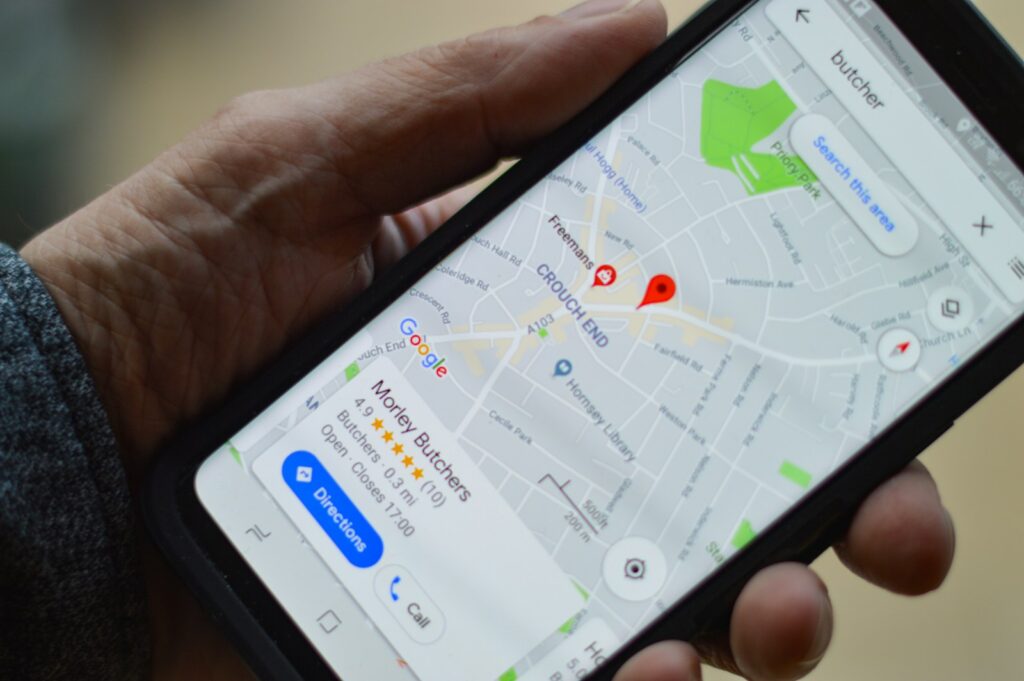
Businesses that land in Google’s local pack — the three-listing map block above the standard organic results — get 126% more traffic and 93% more calls, clicks, and direction requests than businesses ranking positions four through ten. That gap is why “local SEO services” gets searched at all: for a huge share of local businesses, the local pack is worth more than the entire rest of page one combined.
The local pack’s outsized share of clicks and calls reflects a genuinely different search behavior pattern than a purely informational query triggers. Someone searching “plumber near me” or “dentist Zürich” is almost always close to a decision, and the local pack presents exactly the information that decision requires — location, hours, rating, a direct call button — without requiring a click through to a website at all. That’s a meaningful part of why local pack visibility converts so disproportionately well compared to standard organic listings below it: the searcher’s actual need (find someone nearby, right now, who looks trustworthy) is satisfied almost entirely within the local pack interface itself, making it the highest-leverage single piece of real estate on the results page for any business serving a local, decision-ready audience.
What’s Actually Inside a Local SEO Service
Google Business Profile optimization, citation building and consistency across directories, review generation and response management, location-specific landing pages if you serve multiple areas, and local link building from genuinely local sources — a chamber of commerce, a regional publication, a local business association. A service that only touches your Google Business Profile and calls it “local SEO” is doing maybe a third of the actual work. This applies just as much to specific verticals — the mechanics look similar whether you’re a dental practice competing on “dentist near me” searches or a brokerage relying on local visibility for real estate.
What ties all five of these components together, and what a lot of budget “local SEO packages” miss, is that they reinforce each other rather than operating as independent checklist items. A well-optimized Google Business Profile without genuine reviews behind it looks incomplete to a searcher deciding between options. Genuine local content without consistent citations pointing back to it undersells the authority that content should be building. Local links from a chamber of commerce or regional publication carry more weight when they’re pointing to a business whose citations and profile already present a consistent, trustworthy identity. Treating these as five separate line items to check off, rather than as a genuinely interconnected system, is exactly how a business ends up paying for “local SEO” and seeing underwhelming results despite technically having each individual component addressed on paper.
The Local Pack Advantage, In Numbers
Businesses in Google’s local pack get 126% more traffic and 93% more calls, clicks, and direction requests than businesses ranking positions four through ten.
Try It: What’s Your Biggest Local SEO Gap?
This is the highest-leverage gap. GBP optimization accounts for an estimated 36% of local pack ranking signals. A profile treated as “set and forget” is leaving the largest single ranking factor unmanaged.
Second priority. Review recency and volume trend matter more than star rating alone. A simple, low-friction review request process built into customer touchpoints tends to outperform occasional manual asks.
Worth an audit. Inconsistent business name, address, or phone number across directories actively undermines the credibility signal search engines use to confirm your business identity.
Interactive tool: an infrequently updated Google Business Profile is the highest-leverage gap, slow review accumulation without follow-up is second priority, and inconsistent citations are worth auditing.
The Profile Completeness Number That Should Change How You Shop for This
Businesses with fully completed, regularly updated Google Business Profiles appear in the local pack 63% more often than those with incomplete profiles, and receive 70% more location visits. GBP optimization now accounts for an estimated 36% of all local pack ranking signals, up from 32% just a few years ago — which means a service provider who treats your profile as a one-time setup rather than an ongoing task is leaving a growing share of the ranking equation unmanaged.
The rising 32%-to-36% share of ranking signals attributable to GBP optimization reflects a broader pattern in how Google has evolved local search: Google Business Profile has steadily absorbed more of the local ranking decision as the company has built out more features directly inside the profile itself — posts, Q&A, booking integration, product listings, service menus — each new feature representing another surface where an actively managed profile pulls further ahead of a neglected one. A profile from three years ago that was genuinely complete by that era’s standard is likely missing several of these newer feature areas today, simply because Google added them after the profile was originally set up and nobody went back to fill them in. This is the practical argument for genuinely ongoing management rather than a one-time optimization pass: the definition of “complete” itself keeps expanding as Google adds new profile capabilities, and a profile frozen at its original setup state gradually falls further behind that moving target even without anything about the business itself changing.
| Local SEO component | What “done properly” looks like | Common shortcut to watch for |
|---|---|---|
| Google Business Profile | Regularly updated, posts, Q&A monitored, photos current | One-time setup, never touched again |
| Citations | Consistent NAP across relevant, real directories | Bulk submission to hundreds of low-quality directories |
| Reviews | Proactive requests built into customer touchpoints | Purely reactive — only responding to what shows up |
| Local content | Genuine location-specific pages with real local detail | Duplicate templated pages with only the city name changed |
| Local links | Genuine relationships (chambers, associations, local press) | Generic directory links with no local relevance |
Questions Worth Asking Before You Hire
How often is the Google Business Profile actually updated versus set up once? Is citation building done manually against real, relevant directories, or bulk-submitted to hundreds of low-quality ones? Is review management proactive (asking happy customers) or just reactive (responding to what shows up)? The answers separate services doing real ongoing local SEO work from ones selling a single setup fee and calling it done.
Once your profile and citations are in order, the next layer is understanding exactly how “near me” search behavior works and what it takes to actually win those queries — covered in our breakdown of near-me search and local pack mechanics.
Why Citation Consistency Is Worth More Attention Than It Gets
Citation consistency — making sure a business’s name, address, and phone number appear identically across every directory, review site, and mention on the web — sounds like a minor housekeeping detail compared to more visible tactics like review generation or content creation, but it plays a specific and underappreciated role in how Google establishes confidence in a local business’s identity and legitimacy. When the same business appears under slightly different name variations, at addresses that don’t quite match due to a past relocation, or with an outdated phone number still listed in some directories, Google’s systems have to work harder to confirm these mentions all refer to the same real business rather than treating them as ambiguous or even suspicious signals. A business with clean, consistent citations gives search engines an easy, confident identity match; a business with fragmented citations makes that matching process harder, which can quietly suppress local pack visibility even when every other element — reviews, content, links — is strong. We routinely find this exact fragmentation during initial audits for businesses that have moved locations, rebranded slightly, or simply accumulated inconsistent listings over years of never checking, and cleaning it up is often one of the fastest, cheapest wins available in a local SEO engagement.
A Worked Example: The Restaurant With Three Addresses
A Swiss restaurant client came to us after a location move six months earlier, having updated their website and Google Business Profile but nothing else. An audit found the old address still listed as the primary business address on eleven separate directories and review platforms, creating a genuinely confusing signal — some search results showed the new location, others the old one, and a customer searching for directions had a real chance of being sent to the wrong address entirely. We spent two weeks systematically updating every discoverable citation to the new address, a task that required manually logging into or contacting each individual directory since there’s no single tool that updates all of them simultaneously. Within six weeks of completing the cleanup, the restaurant’s local pack visibility improved measurably for their core search terms, and — more concretely — customer complaints about being sent to the old address, which had been a recurring minor headache for the business, stopped entirely. This is a case where the SEO benefit and the basic customer service benefit pointed in exactly the same direction, which isn’t always true of SEO work but made the value of the fix immediately obvious to the business owner.
Multi-Location Businesses Face a Different Version of This Problem
Everything above assumes a single-location business, but Swiss businesses operating across multiple cities or cantons face a structurally different local SEO challenge: each location needs its own genuinely distinct, locally-relevant presence rather than a single generic page duplicated across locations with only the city name swapped. Google’s systems are reasonably good at detecting duplicated, templated location pages, and treating each location as a copy-paste exercise tends to produce weak visibility for every location simultaneously rather than strong visibility for any of them. Genuine location differentiation means unique local content on each location page (actual neighborhood references, location-specific service availability, genuinely different photos), a separate Google Business Profile per physical location rather than one profile awkwardly representing multiple addresses, and location-specific review generation and response, since reviews for one location shouldn’t be commingled with another’s. This is meaningfully more work than single-location local SEO, which is part of why multi-location businesses often see the biggest return from investing properly in this area — most of their competitors are cutting the corner of templated, undifferentiated location pages, leaving real opportunity for a business willing to do the more thorough version.
Measuring Whether Local SEO Is Actually Working
A local business owner checking rankings from their own phone or laptop is measuring the wrong thing more often than not, since Google personalizes local pack results based on the searcher’s actual location — a business owner sitting in their own shop will often see their business rank higher than a customer searching from three streets away actually would. This creates a false sense of security that’s genuinely common: an owner convinced their local SEO is working because they personally see strong rankings, when a customer’s actual experience looks meaningfully different. The fix is straightforward but frequently skipped — use a proper rank-tracking tool that simulates searches from multiple points across the actual service area, or at minimum ask a few genuinely local contacts unconnected to the business to check and report back what they see. Direction requests, phone calls, and website clicks tracked directly through the free Google Business Profile insights dashboard are a more reliable ongoing signal than self-checked rankings, since they reflect real customer behavior rather than a potentially personalized, unrepresentative snapshot from the owner’s own device — and a genuinely simple monthly habit of reviewing those four numbers together tells an owner far more than an occasional anxious rankings check ever will.
Frequently Asked Questions
What should a local SEO service include at minimum?
Ongoing Google Business Profile management, consistent citation building, active review generation, and local link building — not just a one-time profile setup.
How much does an incomplete Google Business Profile actually cost me?
Roughly 70% fewer location visits and a 63% lower chance of appearing in the local pack compared to a fully completed, regularly updated profile.
How important is citation consistency compared to reviews or content?
More important than it’s usually given credit for — fragmented business information across directories can quietly suppress local pack visibility even when reviews and content are otherwise strong, since it makes identity confirmation harder for search engines.
Can I use the same page template for each location of a multi-location business?
Not effectively — duplicated, templated location pages tend to produce weak visibility across all locations. Each location needs genuinely distinct local content and its own Google Business Profile.
Want your local presence audited as an interconnected system, not a checklist of one-time setup tasks? See our Local SEO service.