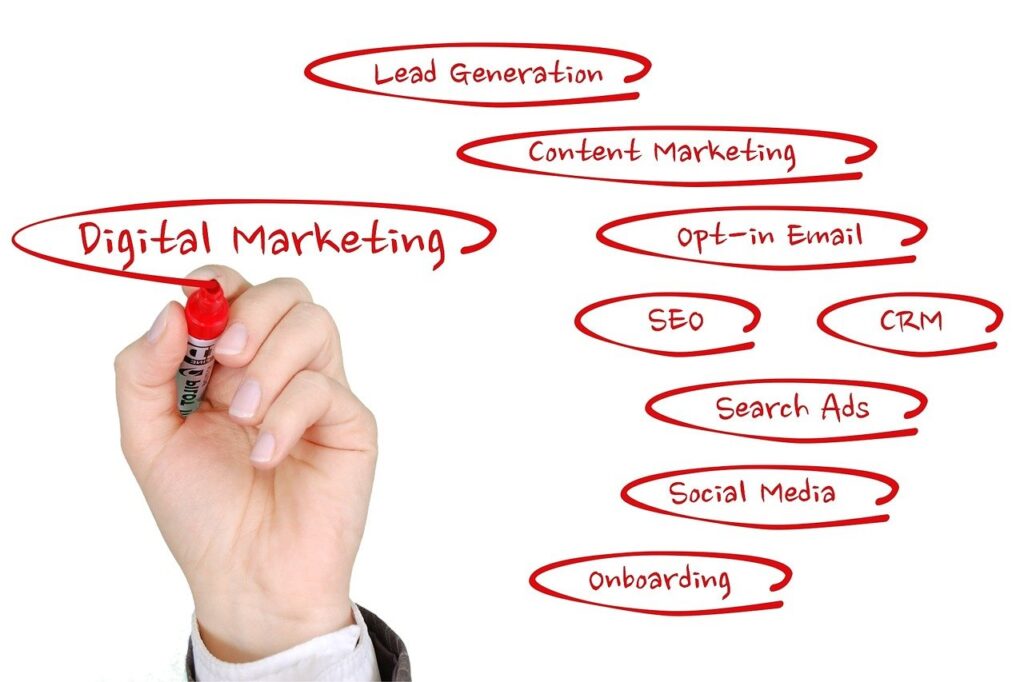
Digital marketing is a set of interlocking pieces — SEO, paid ads, email, social — that businesses earn $5 back for every $1 spent on average, but only when the pieces are actually working together rather than run as disconnected, uncoordinated efforts. 73% of small businesses globally aren’t confident their current marketing strategy is working, and the most common root cause we see isn’t any single channel underperforming; it’s channels operating in isolation with no shared strategy connecting them.
The $5-per-$1 average is worth treating as a rough directional benchmark rather than a promise, since it blends businesses executing genuinely well-coordinated strategies with businesses running the same nominal channels in isolation and seeing far less return — the average obscures a wide range of actual outcomes depending entirely on execution quality and channel coordination, not just channel selection. A business reading that $5 figure and expecting it to apply automatically regardless of how the channels are actually run is setting an expectation the data doesn’t really support; the number describes what’s achievable with genuine coordination, not a guaranteed floor for simply having a presence on multiple channels.
Try It: How the Pieces Actually Connect
Its real job: capture existing search demand, slowly and durably. Connects to: feeds paid ads by revealing which keywords convert before you spend to test them; feeds email by generating the organic traffic that becomes list signups.
Its real job: convert people who already know you, cheaply and repeatedly — averaging $36-$40 ROI per $1 spent. Connects to: nurtures leads that SEO and paid ads generate but don’t convert immediately.
Its real job: generate immediate, controllable volume while organic channels compound. Connects to: tests messaging and offers fast, which SEO content can then be built around once you know what actually resonates.
Its real job: build awareness and relationships with people not yet actively searching. Connects to: feeds the top of the funnel that SEO and paid search later capture once that awareness becomes active intent.
Interactive tool showing how SEO, email, paid ads, and social media each serve a distinct role and feed into the others rather than functioning as isolated, competing channels.
The Multi-Channel Advantage, Visualized
Multi-channel small businesses are 53% more likely to succeed with email, perform 43% better in paid social, and report 21% stronger search marketing results compared to single-channel competitors.
Notice the direction of causation implied here: each channel performs better in the presence of the others, not just alongside them. Email doesn’t just add incremental reach on top of SEO — it performs 53% better when it exists as part of a coordinated multi-channel strategy, most likely because the audience arriving via other channels is warmer and more receptive by the time email reaches them. This is the practical case against picking “the one best channel” and ignoring the rest, a trap a lot of resource-constrained beginners fall into believing focus means doing one thing well rather than a few things connected well.
Why Most Beginners Get the Sequencing Backwards
A common beginner instinct: start with paid ads because they’re the most immediately visible and controllable, then think about SEO and email “later” once there’s budget. We’d argue the more resilient sequence often runs the other direction, or at least in parallel from day one — SEO and email are the channels that keep compounding after you stop actively spending on them, while paid ads stop producing the moment the budget stops. A business that spends its first year purely on paid ads has nothing left when the budget runs out; a business that also invested in even modest organic content and email list-building during that same year has assets that keep working afterward.
The Budget Reality Most Beginners Are Actually Working With
52% of small businesses have monthly marketing budgets under $1,000, and 66.3% spend less than $1,000 a year total — both figures well below what most “comprehensive digital marketing strategy” advice implicitly assumes. This isn’t a reason to give up on multi-channel thinking; it’s a reason to sequence it deliberately rather than trying to run five channels at once with insufficient budget for any of them to actually work. A genuinely limited budget is better spent doing two channels adequately than five channels too thinly to move anything.
A Realistic Starting Combination
| Priority order | Channel | Why it comes at this point |
|---|---|---|
| 1 | Google Business Profile + basic on-site SEO | Free or near-free, compounds immediately, captures existing local demand |
| 2 | Email list-building | Highest ROI channel once you have any traffic at all to convert into subscribers |
| 3 | One paid channel, tightly targeted | Adds controllable volume once the free-tier fundamentals are in place |
| 4 | Social media, chosen deliberately | Pick the one platform your actual customers use, not every platform that exists |
Organic Search’s Underrated Position
49% of businesses say organic search brings them the best marketing ROI of any channel — a genuinely striking figure given how much marketing conversation and budget skews toward paid and social. Part of why this gets underweighted by beginners specifically: SEO’s payoff is invisible in the short term in a way paid ads and social posts aren’t, so it’s easy to deprioritize in favor of channels that show immediate, visible activity. The businesses reporting the best organic ROI are almost always ones that treated it as a genuine strategic investment from early on, not an afterthought squeezed in once other channels’ budgets were already committed.
If you’re specifically weighing Google Ads against Meta Ads for the paid piece of this mix, that decision is covered in more depth in our platform comparison guide.
The Confidence Gap, and Why It’s Actually a Data Problem
73% of small businesses aren’t confident their marketing is working — a striking number given how much money is being spent based on that uncertain footing. In our experience, this confidence gap is rarely about the marketing itself failing; it’s much more often about the business having no clear way to measure whether it’s working at all. A business running Google Ads, posting on Instagram, and sending occasional emails, without a shared system connecting a customer’s actual purchase back to which channel (or combination of channels) actually influenced it, has no real basis for confidence either way — good or bad. The uncertainty isn’t a verdict on the marketing; it’s a symptom of missing measurement infrastructure, and it’s fixable independent of which channels you’re actually running.
A simple, low-cost starting point that most beginners skip: a single “how did you hear about us” question at the point of sale or in a post-purchase email, tracked consistently over time. It’s not as precise as full digital attribution modeling, but it’s dramatically better than no data at all, and it’s achievable on day one without any technical setup, which makes it a genuinely practical starting point for a business without the resources for a more sophisticated tracking system yet.
What “Learning Digital Marketing” Actually Requires Early On
A beginner doesn’t need to become an expert in every channel simultaneously — that’s an unrealistic bar that discourages more people than it helps. What actually matters early on is understanding the connective logic covered above well enough to make reasonable sequencing decisions, and being honest about which channels align with how your specific customers actually make decisions. A B2B consultancy investing heavily in Instagram before building any search presence is optimizing for a channel most of its actual buyers don’t use for professional purchasing decisions, regardless of how well-executed the Instagram content is. Matching channel choice to actual customer behavior, even imperfectly, beats technical mastery of a channel your customers don’t use.
A Worked Example: Sequencing From Zero
A newly opened Swiss home services business came to us with a modest marketing budget and no existing online presence whatsoever — no website beyond a single-page placeholder, no Google Business Profile claimed, no email list. Rather than trying to launch all channels simultaneously, we followed the priority sequence above deliberately. Month one focused entirely on Google Business Profile completion and a handful of genuinely useful service pages on a simple website — no paid spend at all, just the free-tier fundamentals done properly. Month two added a simple email capture on the site (a genuinely useful seasonal maintenance checklist offered in exchange for an email address, not a generic “sign up for our newsletter” ask that converts poorly) alongside continued content work. Only in month three did we introduce a tightly targeted, modest Google Ads campaign, built directly around the specific keywords the site’s own early organic traffic had already shown converted best — meaning the paid campaign started with real data about what worked rather than guessing. By month six, the business had a functioning, self-reinforcing system: organic traffic feeding email signups, email nurturing leads that weren’t ready to convert immediately, and paid ads amplifying the keywords already proven to work rather than blindly testing from scratch. This sequence took longer to show early results than jumping straight into paid ads would have, but produced a considerably more durable foundation, with organic and email channels continuing to produce leads at essentially zero marginal cost well after the initial paid campaign’s budget had been fully spent.
The Mistake of Treating Digital Marketing as a Checklist
A genuinely common failure pattern among businesses trying to learn digital marketing from scratch is treating it as a checklist of tactics to complete rather than a set of interconnected decisions requiring ongoing judgment. A business that sets up a Google Business Profile, publishes ten blog posts, runs a Google Ads campaign for a month, and posts on Instagram twice a week has technically “done” digital marketing in a checklist sense, without necessarily having built anything that compounds or reinforces itself the way the multi-channel data above describes. The connective tissue — making sure the blog content actually targets the keywords that convert, making sure the Google Ads campaign feeds insights back into content strategy, making sure the Instagram presence drives toward the email list rather than existing in isolation — is the part that turns a checklist of activities into an actual system, and it’s also the part that’s hardest to teach through a generic guide, since the right connections depend on the specifics of a given business’s customers and sales process.
Knowing When to Bring in Outside Help
Not every business needs to outsource digital marketing from day one, and a genuinely resource-constrained business often learns more from running the fundamentals themselves first — claiming a Google Business Profile, writing a handful of genuinely useful pages, sending a first email campaign — than from handing everything to an agency before understanding what’s actually involved. The point at which outside help typically starts paying for itself is when the business has validated that the fundamentals work (some organic traffic, some email engagement, some early paid ad data) but lacks the internal time or expertise to scale that validated foundation into a genuinely coordinated multi-channel system. Bringing in help before that validation stage often means paying for expertise applied to an unproven foundation; bringing it in after tends to apply that same expertise to something already shown to have real traction, which is a meaningfully better use of the investment. It also puts the business in a much stronger position to evaluate whatever outside help it does bring in, since it now has real, first-hand data to compare against any agency’s proposed strategy and reported results, rather than having to take claims about “what should work” purely on faith.
Related Guides
- how to choose an SEO agency as a small business — the vetting questions that separate a legitimate agency from a risky one.
- a low-budget digital marketing starting point — where to start when the marketing budget is genuinely small.
- why digital marketing stopped being optional for law firms — the ROI case for firms that have been slow to invest.
- hiring a contractor versus an agency — what actually changes in practice between the two models.
Frequently Asked Questions
Which digital marketing channel should a total beginner start with?
Google Business Profile and basic on-site SEO — they’re free or near-free and compound immediately, giving you a foundation to build the other channels on.
Is it better to focus on one channel or spread across several?
Multi-channel businesses consistently outperform single-channel ones, but only when each channel gets enough budget to actually work — two channels done adequately beats five done too thinly.
Why does email marketing have such a high reported ROI?
It converts people who already know your business, cheaply and repeatedly, and performs even better when fed by warm traffic from other channels like SEO and paid ads.
When should a small business bring in outside marketing help?
Generally once the fundamentals are validated — some organic traffic, some email engagement, some early paid data — rather than before, so outside expertise gets applied to a proven foundation instead of an unproven one.
Want a digital marketing strategy where the channels actually reinforce each other rather than competing for the same limited budget, sequenced sensibly around your specific customers and current stage? See our pricing.